

Blog
A Fishing Spider Finds the Fishing Gear!

An Unexpected Wildlife Encounter in Our New Hampshire Shed
DG Videtto — Woodland Enthusiast • American Storyteller
An Unexpected Visitor
As autumn settled into New Hampshire, my husband John and I were busy preparing our shed for winter. Seasonal belongings needed to be put away, and our electric bikes were being stored until spring.
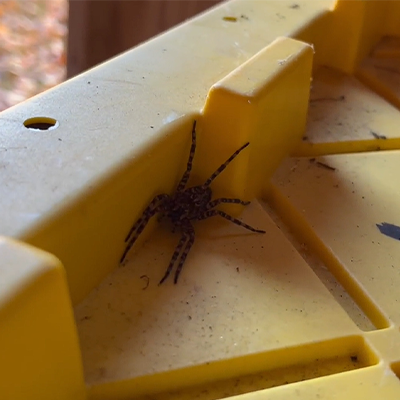
Everything was moving along nicely until something caught my attention. A rather impressive spider was resting on the edge of a yellow storage container. Naturally, I stopped to investigate.
John, on the other hand, was considerably more interested in finishing the work.
What made this discovery particularly amusing was the spider’s choice of resting place. The storage box was labeled “BIKE,” but inside was our fishing gear. And sitting right there, as I would soon discover, appeared to be a dark fishing spider! Sometimes nature has a wonderful sense of humor.

Photo 1 — The spider on the box labeled “BIKE,” with fishing gear above.
Curiosity Gets the Better of Me
The spider seemed perfectly relaxed, giving me time to observe it and do a little research. Having experienced unidentified spider bites in the past, I’m careful around unfamiliar spiders. My first concern was whether this visitor might be dangerous, perhaps something like a brown recluse.
Using the iNaturalist app, I began investigating its identity. Whenever I encounter unfamiliar wildlife, I generally want to know two things: Is it native to New Hampshire, and does it play a beneficial role in our environment?
Meanwhile, John came over, took a look, and politely tried to share my enthusiasm. Then he jokingly suggested the spider might jump on me, crawl down my throat, and lay eggs! We had some fun with that one.
For the record, spiders don’t reproduce that way. Our visitor seemed far more interested in remaining on the storage container than in either of us.
Meet the Dark Fishing Spider
The iNaturalist identification suggested a dark fishing spider (Dolomedes tenebrosus), a species native to eastern North America, including New Hampshire. Despite its name, this spider does not need to live beside water. It can be found in wooded habitats, on tree trunks, and around buildings.

Photo 2 — Close-up of the spider identified by iNaturalist as a dark fishing spider.
A few things I learned about dark fishing spiders:
- Large females can have leg spans exceeding three inches.
- They hunt insects and other small invertebrates rather than relying on a prey-catching web.
- As predators, they play a role in local food webs.
- They can bite defensively if threatened or handled, but are not generally considered medically dangerous to people.
- Females carry egg sacs and later build nursery webs to protect their young.
Brown recluse spiders are not established in New Hampshire, although an occasional spider can be transported beyond its normal range. It still makes sense to identify unfamiliar wildlife and avoid handling it.
Sharing Our Spaces With Wildlife

Photo 3 — Our visitor resting on the raised edge of the storage lid.
Our shed is generally quiet throughout winter. Once the seasonal belongings are put away, there is little reason to disturb the space until spring. I know spiders sometimes make themselves at home there, and whenever possible, I prefer to leave them undisturbed.
Of course, I take precautions. Having been bitten before, I’m mindful when moving stored items or reaching into places where spiders might be hiding. But I don’t believe every unfamiliar creature needs to be removed simply because it surprises us.
Learning about an animal’s natural history and ecological role can change how we view it.
A Little Wildlife Discovery Close to Home
With our unexpected visitor left undisturbed, John and I returned to preparing the shed for winter. We had accomplished what we set out to do, shared a few laughs, and discovered something new along the way.
And somewhere among our fishing equipment, a dark fishing spider reminded me that fascinating wildlife doesn’t always require a journey into the forest. Sometimes, it’s waiting right in our own backyard.
Critters Captured — Wildlife Captured on Film, Not in Hand