
Blog
Japanese Knotweed: Why Awareness Begins with Identification

Pause. Zoom. Identify.
Japanese Knotweed: Why Awareness Begins with Identification
By DG Videtto | Woodland Enthusiast | American Storyteller
Plant identification is based on field observations and use of a nature identification app.
Sometimes learning about the natural world begins with simply noticing what is growing around us. As a woodland enthusiast, I have become increasingly curious about the plants I see along roadsides, woodland edges, waterways, parking areas, and other disturbed spaces.
Japanese knotweed (Reynoutria japonica) is one invasive plant that has especially caught my attention in New Hampshire. The more I learn to recognize it, the more I understand why identification matters before we disturb a plant, move soil, or dispose of plant material.
Japanese knotweed growing along the edge of a disturbed gravel area in New Hampshire. Photograph by DG Videtto.
What I Am Learning to Look For
Japanese knotweed can be recognized by looking at several characteristics together rather than relying on a single feature. Broad leaves, jointed bamboo-like stems, and dense colonies are useful clues.
Leaves
The leaves are broad and generally have a flat or somewhat heart-shaped base. Leaf shape can vary, so identification should be based on several characteristics.
Stems
The stems are jointed and bamboo-like, with distinct nodes. Mature stems are typically hollow between the nodes and may show reddish or purple markings.
Growth Pattern
Japanese knotweed can form large, dense colonies, particularly in disturbed areas and along roadsides and waterways. A dense stand is often one of the first things that catches my attention from a distance.
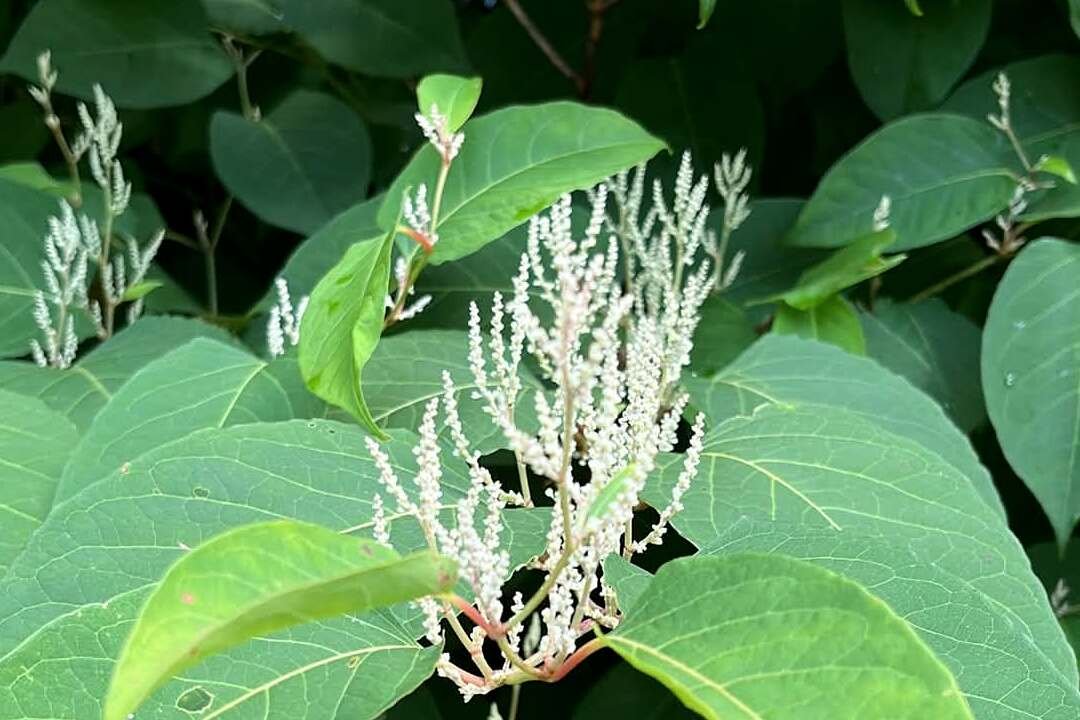
Japanese knotweed leaves and pale flower clusters photographed near the Saco River in North Conway, New Hampshire. Photograph by DG Videtto.
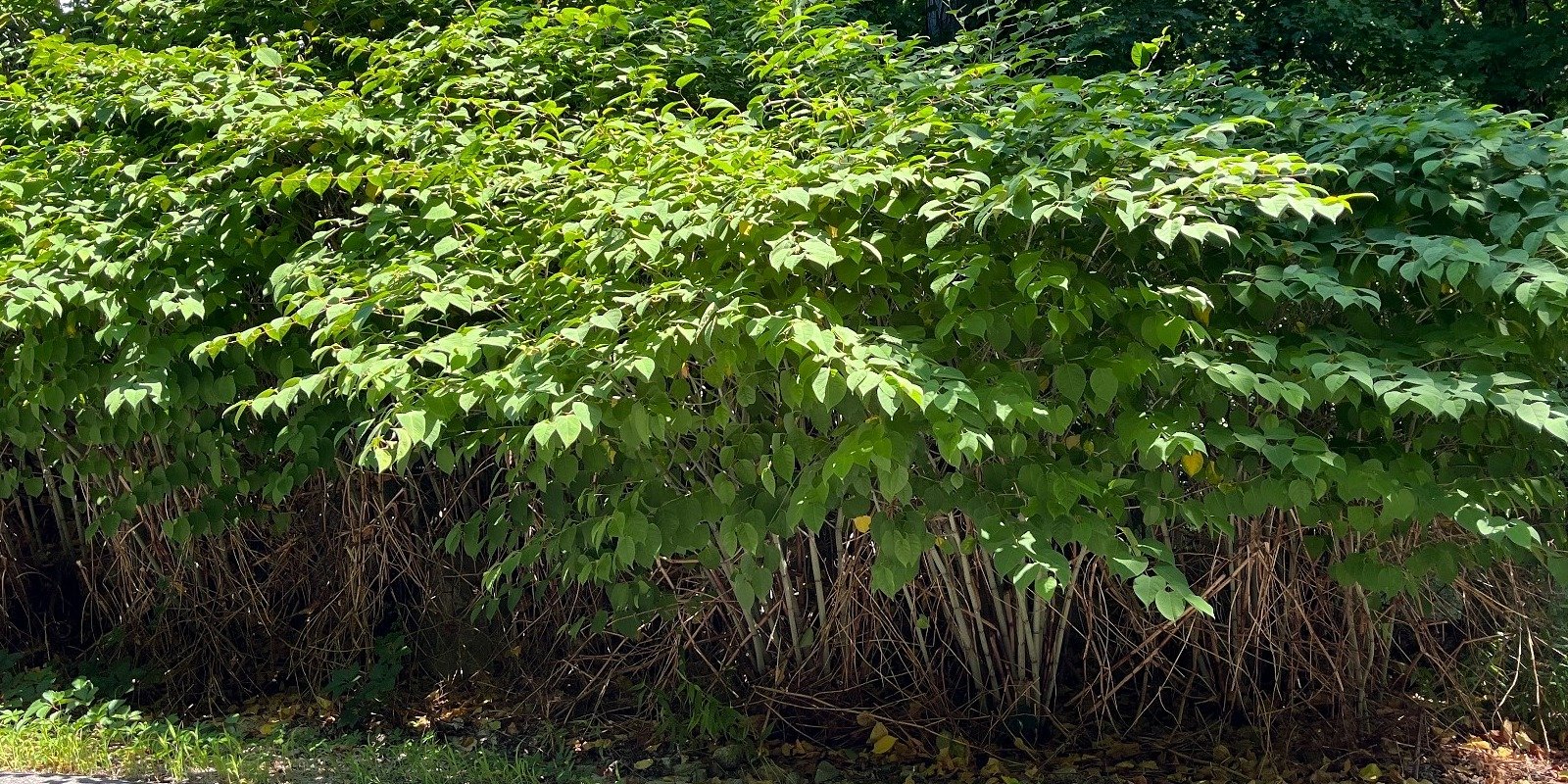
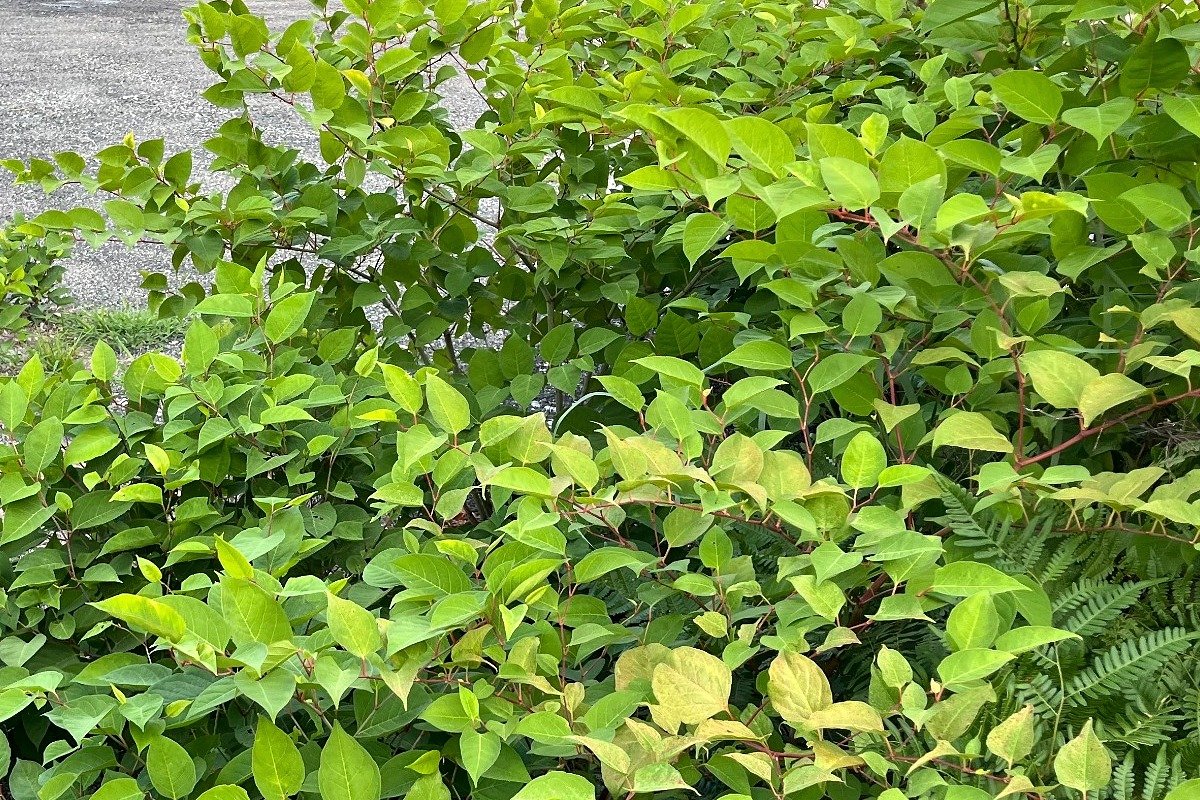
Dense Japanese knotweed stand showing upright stems beneath the foliage at a New Hampshire location near a dam. Photograph by DG Videtto.
What I Am Learning: How It Spreads
One of the most important things I have learned is that Japanese knotweed can spread vegetatively. Its underground rhizomes are especially important, and pieces of plant material can contribute to new growth.
This means activities that disturb or move soil and plant material deserve attention. Construction, excavation, roadside work, landscaping, mowing or cutting, flooding, and improper disposal can potentially move rhizomes or plant fragments to new locations. Seed reproduction can occur, but vegetative spread through rhizomes and plant fragments is a major concern.
My takeaway: pause before disturbing an unfamiliar plant, identify what is growing there, and research appropriate management and disposal methods before taking action.
How Japanese Knotweed Can Affect Wildlife Habitat
What interests me most is not simply the presence of an invasive plant, but how a change in vegetation can affect the larger habitat. Japanese knotweed can form dense stands that reduce the variety and abundance of native plants beneath and around it. When native vegetation is displaced, the effects can extend beyond plants because insects, birds, mammals, and other wildlife depend on native plant communities for food, shelter, nesting materials, and cover.
Along streams and riverbanks, researchers have also studied how dense knotweed stands can change riparian plant communities and the invertebrates associated with them. The effects are complex and can vary by location, so I do not assume that seeing knotweed automatically tells us exactly what is happening to wildlife at a particular site. For me, it is another reason to observe carefully, ask questions, and turn to qualified experts and reliable research.
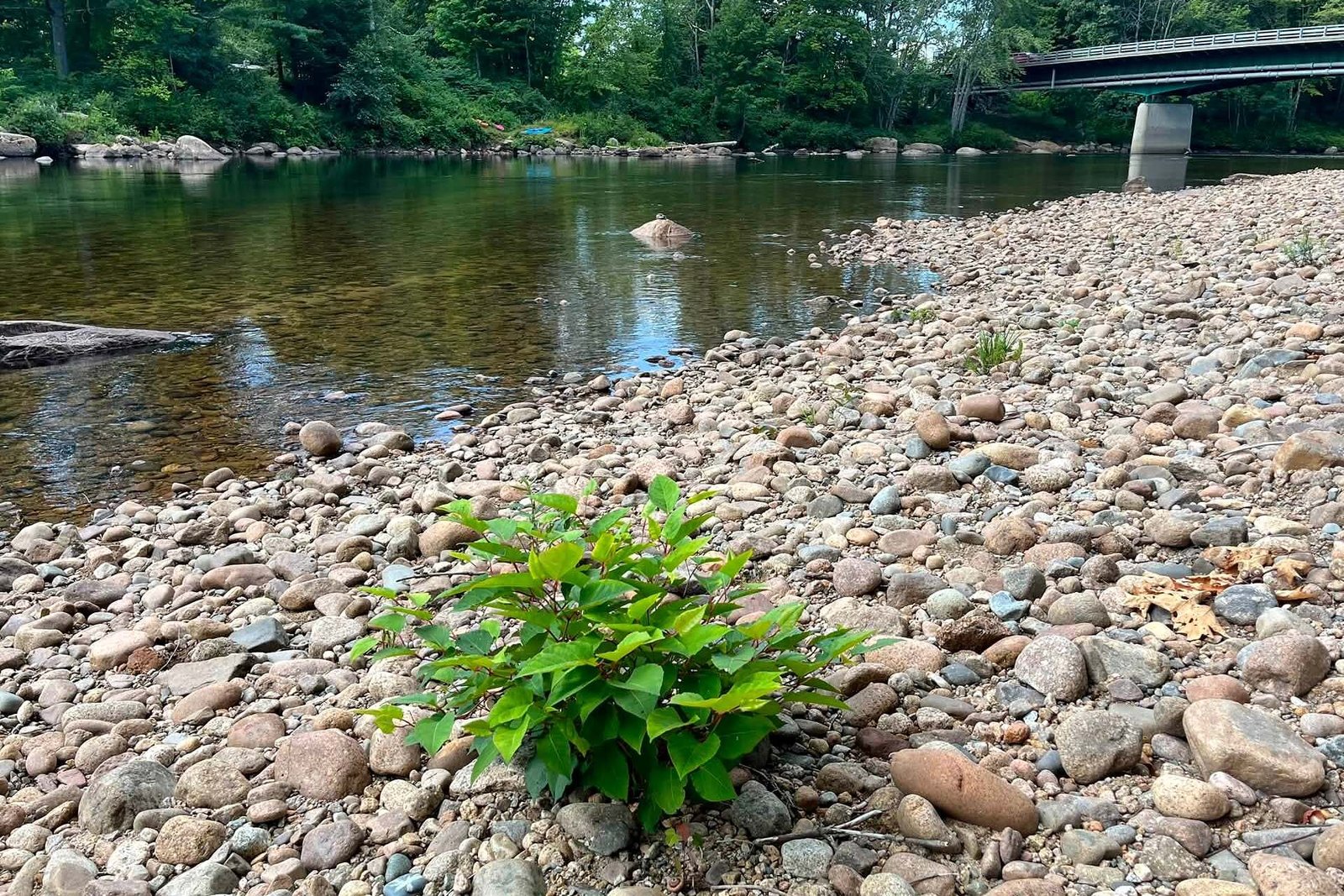
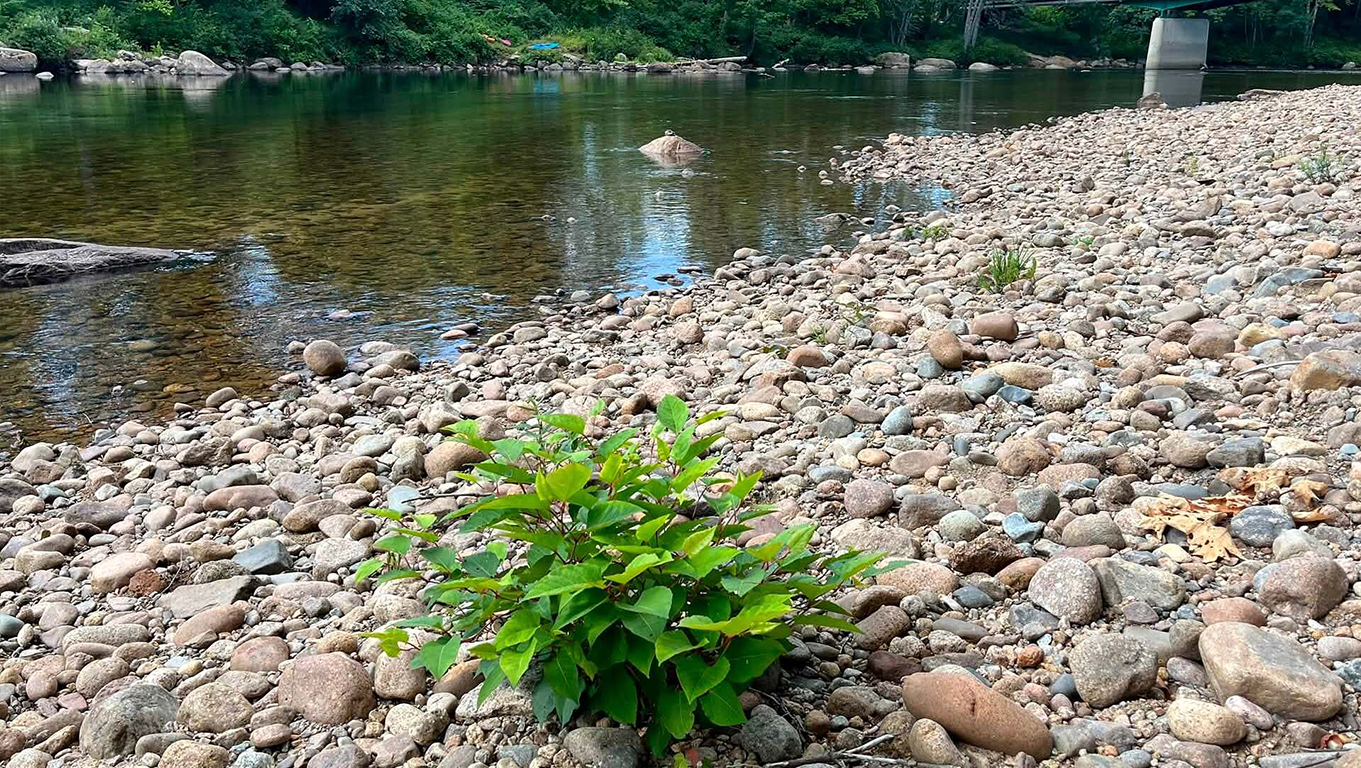
Japanese knotweed growing from the rocky shoreline of the Saco River in North Conway, New Hampshire. Photograph by DG Videtto.
Why Environmental Change Inspires Stories
As a children’s author, this is where observation connects with storytelling for me. A change to a forest, wetland, roadside, or other habitat is not only a change in the landscape. It can change the world that woodland creatures depend upon.
I believe stories can help children and families explore those changes in a way that facts alone sometimes cannot. A fictional animal can lead readers into questions such as: What happens when familiar plants disappear? Where does an animal find food or shelter when its habitat changes? What happens when something introduced begins to dominate a place?
The stories do not need to provide all the answers. Their role can be to create curiosity, encourage discussion, and inspire readers to look more closely at the natural world around them. That is one reason my field observations and the Roadside Series matter to me: what I notice outdoors often leads to new questions about the relationship between plants, wildlife, people, and changing landscapes.
Pause. Zoom. Identify. – The Roadside Series
My Roadside Series on YouTube grew from this same curiosity. The purpose is to give everyday people an opportunity to practice plant identification skills using real roadside vegetation and to encourage learning about the natural world around us.
PAUSE. ZOOM. IDENTIFY.
Pause before the identification is revealed. Zoom in on the leaves, stems, flowers, fruit, growth pattern, and surrounding habitat. Identify what you think you see, then compare your observation with a nature identification app and reliable public resources.
Watch the Roadside Series on YouTube: Roadside Series Playlist
A Community Idea Worth Sharing
While researching Japanese knotweed, I learned about the Town of Carlisle, Massachusetts, and its Japanese Knotweed Disposal Program. The town provides residents with an opportunity to bring Japanese knotweed to the transfer station for placement in a designated disposal container.
There is a lot to unpack in a program like this, but I found the concept interesting because disposal is an important part of the invasive-plant conversation. Communities interested in reducing the movement of invasive plant material through ordinary yard-waste or compost streams may find Carlisle’s program worth reviewing and discussing locally.
Learn more from the Town of Carlisle: Japanese Knotweed Disposal Program
Why I Keep Looking
A roadside can tell us much more than we might expect. It can reveal native plants, invasive plants, pollinator activity, seasonal changes, disturbed habitats, and the ways vegetation responds to human activity.
The goal is not to know every plant or to become an expert overnight. For me, the value is in becoming more observant, asking better questions, using reliable resources, and learning from people with expertise.
Keep looking. Keep asking questions. Stay curious. Keep learning.
Disclaimer
I am not an expert. Plant identification in this article is based on field observations, publicly available information, and use of a nature identification app. Observations and identifications may not always be accurate or complete. This content is intended to encourage curiosity, awareness, discussion, and learning. Always consult qualified experts and appropriate local or state authorities for confirmed plant identification, invasive-species management, disposal recommendations, or land-management decisions.